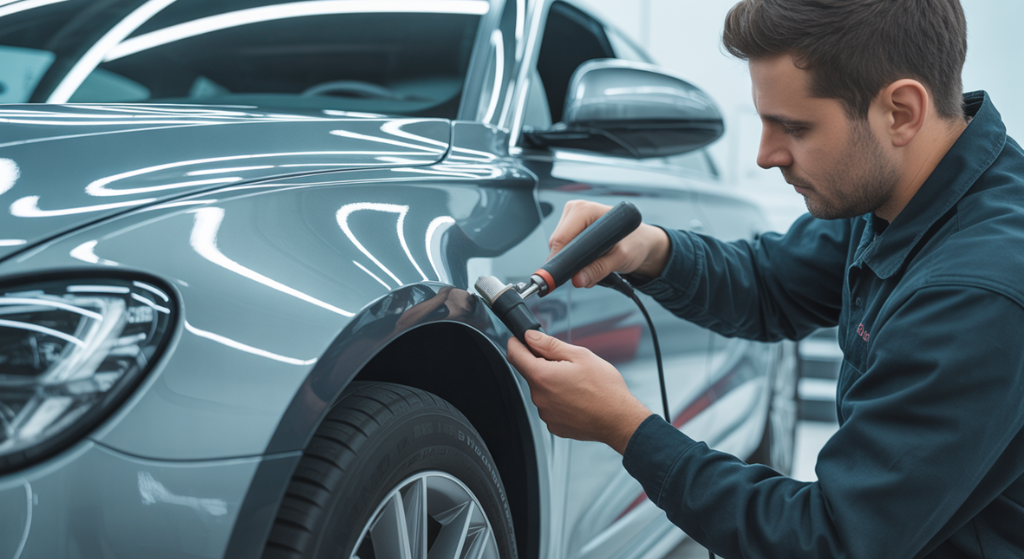
Finding a dent in your car is a universal frustration. Whether it was a runaway shopping cart, a careless door opening in a parking lot, or a sudden hailstorm, that imperfection in your vehicle’s bodywork is an eyesore. It immediately lowers the aesthetic appeal of your car and, more importantly, its resale value.
If you have been researching repair options, you might have stumbled across the German term Ausbeulstation. While it sounds technical, understanding what this facility offers could save you hundreds of dollars and days of waiting time compared to a traditional body shop.
An Ausbeulstation represents a specialized approach to automotive care that prioritizes precision and preservation over heavy-duty reconstruction. This guide explores exactly what these stations are, the specific techniques they use, and why they are often the superior choice for minor vehicle damage.
What Exactly is an Ausbeulstation?
The term comes from the German language, combining ausbeulen (to hammer out or smooth out dents) and station. In the automotive industry, an Ausbeulstation is a dedicated workshop or a specific zone within a larger repair facility designed exclusively for removing dents.
Unlike a standard auto body shop that focuses on sanding, filling, and repainting damaged panels, an Ausbeulstation focuses on Paintless Dent Repair (PDR). The technicians who work here are often referred to as a Beulendoktor (dent doctor) because of the surgical precision required for their work.
These stations are equipped with specialized lighting systems and ergonomic tools designed to manipulate metal back to its original shape without disturbing the factory paint job. While the term is German, the standards and techniques used in a high-quality Ausbeulstation are recognized globally as the benchmark for efficient cosmetic car repair.
The Core Technique: Paintless Dent Repair (PDR)
The primary service offered at an Ausbeulstation is Paintless Dent Repair. This is an environmentally friendly repair method that restores a vehicle’s body to factory-like condition in a fraction of the time and at a fraction of the cost of traditional body repair.
PDR operates on the principle of metal memory. Vehicle panels are stamped into specific shapes during manufacturing. When a dent occurs, the metal is stressed but often wants to return to its original form. Technicians use this to their advantage.
The Pushing Method
The most common technique involves accessing the back of the dent. Technicians remove interior trim pieces, door panels, or tail lights to get behind the vehicle’s “skin.” Using long, specialized metal rods with polished tips, they gently massage the dent out from the inside. This requires immense patience and hand-eye coordination.
The Pulling Method (Glue Pulling)
Sometimes, the back of a panel is inaccessible, such as on a roof rail or a double-walled section of the car. In these cases, the technician works from the outside. They apply specialized glue tabs to the dent and use a lifting tool to pull the metal up. Once the metal is raised, they knock down any high spots to level the surface.
Why Choose an Ausbeulstation Over a Body Shop?
Opting for a specialized dent repair station offers several distinct advantages over conventional repair methods.
preservation of Resale Value
The most significant benefit is the retention of your original factory paint. Original paint is more durable and higher quality than any repaint job. Because PDR does not involve sanding or painting, there are no concerns about color mismatching or overspray. When you sell the car, it is virtually impossible to tell it was ever damaged.
Cost Efficiency
Traditional repairs are labor-intensive and require expensive materials like body filler, primer, base coat, and clear coat. An Ausbeulstation eliminates these material costs. Since the process is faster, the labor cost is also generally lower. You can often repair a dent for a third of the price of a traditional body shop quote.
Speed and Convenience
A conventional repair can leave you without your vehicle for days or even a week while paint dries and cures. In contrast, many repairs at an Ausbeulstation can be completed in a few hours. Same-day service is the standard, not the exception.
Environmental Impact
Without the need for paints, thinners, and solvents, PDR is a green alternative. It releases no harmful chemicals into the atmosphere and produces significantly less waste.
The Repair Process: Step by Step
When you take your vehicle to an Ausbeulstation, the process is streamlined and transparent.
- Assessment: The technician cleans the panel and sets up specialized LED line boards. These lights cast reflections across the metal, revealing the exact depth and diameter of the dent.
- Access: If necessary, the technician carefully removes interior panels or lights to gain access to the backside of the dent.
- The Repair: Using the appropriate rod or glue tab, the technician begins to work the metal. They make hundreds of microscopic pushes or pulls, slowly restoring the panel’s tension and shape.
- Quality Control: The technician checks the repair from multiple angles using the line board to ensure the reflection is perfectly straight, indicating a flawless surface.
- Reassembly: Any removed parts are reinstalled, and the car is polished.
When is PDR Not Suitable?
While the technicians at an Ausbeulstation are skilled, they are not magicians. There are limitations to what can be fixed without painting.
- Broken Paint: If the impact scratched or chipped the paint deep enough to expose the metal or primer, PDR can fix the dent, but the paint will still need attention.
- Stretched Metal: If the metal has been stretched beyond its elastic limit (often resulting in a very deep, sharp dent), it may not be able to return to its original shape perfectly.
- Location: Dents on the very edge of a panel or directly on a body line are difficult, though not always impossible, to repair.
Restoring Your Vehicle’s Value
Your car is likely the second biggest investment you will make, right after your home. Maintaining its appearance is about pride of ownership and protecting that financial investment. The concept of the Ausbeulstation represents the evolution of auto repair—moving away from invasive, chemical-heavy fixes toward precise, efficient, and non-intrusive restoration.
If your vehicle has suffered hail damage or collected a few parking lot battle scars, look for a certified PDR specialist or an Ausbeulstation. It is the smartest way to erase the damage while keeping your car as close to its factory condition as possible.
Conclusion
Paintless Dent Repair and the concept of the Ausbeulstation represent a modern, efficient approach to vehicle restoration. Choosing these methods not only ensures that your car maintains its original appearance and value but also demonstrates a commitment to sustainable, non-invasive repair solutions. Whether dealing with minor dents or hail damage, trusting a certified specialist guarantees results you can rely on. Preserve the integrity of your vehicle while making an environmentally conscious choice—PDR truly is the future of auto repair.