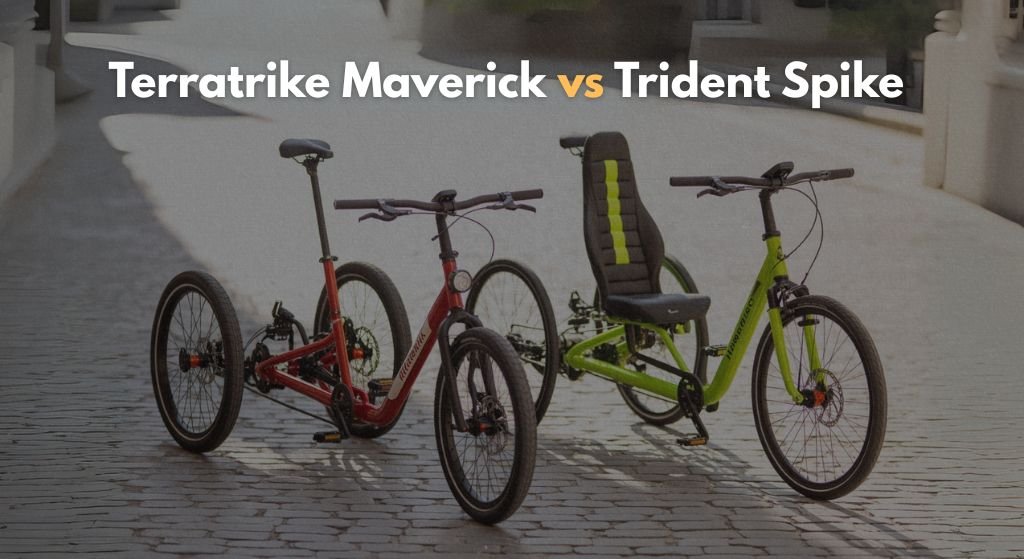
Choosing between the Terratrike Maverick vs Trident Spike is tricky. The Terratrike Maverick and Trident Spike are two popular choices that seem similar but are actually quite different. Both are beginner friendly trikes, yet their features and riding experiences are worlds apart. But the Maverick is simple and sturdy, perfect if you want easy rides around town. The Spike has more features like folding and extra gears, better if you want to try different types of riding.
Terratrike Maverick
Riders who want a dependable, no-frills trike without too many features will find the Terratrike Maverick ideal. Durability is demonstrated by its Hi-Ten steel frame. This gives the Maverick a little more weight, but it guarantees that it can withstand a beating and continue to function. The step-through frame design is one of its best qualities; it makes mounting and dismounting simpler, especially for older or less mobile riders. Because of its direct steering system, steering is simple. It turns as you turn, so there’s no delicate mechanism to figure out. Another useful feature is the adjustable boom, which enables riders of various heights to fit comfortably without the need for special adjustments. In terms of gearing, the Maverick maintains a refreshingly straightforward approach.
Trident Spike
The Trident Spike competes in a different league. Although it is still regarded as entry-level, its many features make it appealing to riders who desire greater versatility. First of all, the frame’s chromoly steel construction effectively balances strength and weight reduction. Compared to the Maverick’s heavier Hi-Ten frame, this makes it feel more nimble and manageable. The folding frame design is what really makes the Spike unique. If you live in an apartment or have to move the trike around a lot, this is a huge help. When folded, it can be conveniently stored in confined areas or in a car trunk. With a 24-speed drivetrain, the Spike offers riders a much greater range of gears to tackle a variety of terrains. Whether it is a long-distance path or a steep hill.
Terratrike Maverick vs Trident Spike Comparison
| Feature | Terratrike Maverick | Trident Spike |
|---|---|---|
| Frame Material | Hi-Ten steel (heavier but durable) | Chromoly steel (stronger and lighter) |
| Frame Design | Fixed frame | Folding frame |
| Weight | Heavier (less nimble) | Lighter (more responsive) |
| Drivetrain | 8-speed Shimano | 24-speed |
| Terrain Capability | Best for flat terrain | Handles variety of terrains (steep inclines to rapid descents) |
| Gear Complexity | Simple, minimal gear changes | Wide range of gearing options |
| Seat Design | Wide and sturdy, basic design | Mesh seat with lumbar support |
| Comfort Duration | Comfortable for rides under 1 hour | Designed for extended rides |
| Breathability | Standard seat | Breathable mesh with airflow |
| Steering | Direct steering, solid and grounded | Direct steering, more responsive and nimble |
| Handling | Smooth, controlled ride | Better for quick turns and confined spaces |
| Maintenance | Low maintenance (fewer parts) | Moderate maintenance (more complex drivetrain) |
| Storage | Requires dedicated space (garage/shed) | Compact folding for tight spaces |
| Portability | Fixed frame, less portable | Foldable, easily transportable |
| Price Range | $1,400 – $1,600 | $1,800 – $2,000 |
| Best For | Leisurely rides, flat terrain, budget-conscious riders | Varied terrain, longer rides, frequent transport/storage |
| Ideal User | Casual riders wanting “set it and forget it” simplicity | Active riders seeking versatility and advanced features |
Frame Design and Build Quality:
The frame material instantly draws attention to the differences between the Terratrike Maverick and Trident Spike. Although much heavier, the Maverick’s Hi-Ten steel is remarkably durable. Although it makes the trike feel less nimble, this weight isn’t a deal breaker for informal, leisurely rides. Conversely, the chromoly steel used in the Spike is stronger and lighter. This results in a more responsive ride, particularly when negotiating curves or going uphill. Regarding construction quality, both trikes are robust and long-lasting with minimal upkeep. However, the Spike’s frame will feel much more useful if you’re concerned about weight and intend to move your trike frequently.
Gearing and Terrain Capability:
The 8-speed Shimano drivetrain of the Maverick is made to be as simple as possible. For riders who would rather ride on flat terrain and don’t want to deal with changing gears frequently, it’s ideal. Riding is simple and maintenance is minimal due to the restricted gear selection. Conversely, the Spike’s 24-speed drivetrain offers a plethora of options. Riders can confidently tackle a range of terrains, from rapid descents to steep inclines, thanks to three times as many gearing options. The Spike’s gear range is a big plus if you ride a variety of routes or are considering going off the local bike paths.
Comfort and Ergonomics:
Although they take different approaches, rider comfort is a top priority for both the Maverick and the Spike. For leisurely rides lasting less than an hour, the Maverick’s wide and sturdy seat provides a comfortable sitting position. Although it is functionally designed, it is devoid of sophisticated ergonomic features. With its mesh seat and lumbar support, the Spike goes above and beyond. Longer rides benefit greatly from this feature, which lessens back strain and improves comfort in general. Additionally, the breathable mesh facilitates airflow, which is advantageous on warmer days. The Spike’s seat design is unquestionably superior if you intend to ride for extended periods of time.
Steering and Handling:
Both models have direct steering, so the trike does what you do with the handlebars while you’re riding. Their frame designs, however, have distinct effects on handling. The Maverick feels solid and grounded because of its larger frame. Although it isn’t made for quick turns, it does a great job of giving you a smooth, controlled ride. Because it is lighter, the Spike feels more responsive and nimble, which facilitates handling abrupt turns and negotiating confined spaces. The Maverick is a good choice if you value a steady, predictable ride. However, the Spike offers a little more agility and responsiveness if that’s what you’re looking for.
Maintenance Requirements:
The Maverick is superior in terms of ease of maintenance. An 8-speed drivetrain requires less maintenance because it has fewer parts that require attention. This is a huge plus for riders who prefer a trike that they can “set it and forget it.” Naturally, the Spike needs a little more attention because of its more intricate 24-speed setup. Although more gears require more adjustments, you can enjoy a far more varied riding experience if you’re prepared to perform the occasional tune-up. Although neither trike requires a lot of maintenance, riders who want less work prefer the Maverick.
Storage and Portability:
The Spike excels in storage, which is frequently the deciding factor. Its folding frame makes it easy to store in tight places, such as car trunks or apartments, by collapsing into a small size. A dedicated storage space, such as a garage or shed, is necessary for the Maverick’s fixed frame. The Spike’s foldable design is a huge plus if you have limited space or intend to move your trike around a lot.
Pricing Breakdown:
An important consideration in the Terratrike Maverick vs. Trident Spike debate is price. One of the most reasonably priced and well-made recumbent trikes available is the Maverick, which retails for between $1,400 and $1,600. The Maverick is a great value for riders looking for a long-lasting, basic ride at an affordable price. The Spike, which costs between $1,800 and $2,000, is more expensive, but its larger feature set which includes foldability, a 24-speed drivetrain, and ergonomic improvements justifies the higher price. The cost of the Spike is well worth it if you have the money and plan to ride more or take on different types of terrain.
Who Should Buy the Terratrike Maverick?
For riders looking for a straightforward, reasonably priced, and reliable trike, the Maverick is ideal. It’s the preferred option for seniors, casual riders, and anyone else searching for a low-maintenance trike for easy park rides and level city streets. If you don’t require portability or sophisticated gearing, the Maverick provides all you require without needless extras.
Who Should Buy the Trident Spike?
The Spike is designed for riders who want to do more than just go for casual rides. The Spike is a better long-term investment if you want to explore a variety of terrains, need a trike that folds up for convenient storage, or want the versatility of a 24-speed drivetrain. It’s perfect for novices who don’t want to outgrow their trike within a year and know they’ll progress to more ambitious riding.
Final Verdict:
In the end, the Terratrike Maverick vs. Trident Spike argument isn’t about which trike is better; rather, it’s about which one best suits your needs. The Maverick will be a great choice for casual riders seeking affordability, ease of use, and unwavering durability. However, the Spike is a definite winner if you plan to travel farther, explore hilly terrain, or require a trike that can fit into small storage areas. Although they are made for different kinds of riders, both trikes are excellent in their respective classes. Determine your riding objectives, evaluate your space requirements, and choose the option that will motivate you to ride more.